Why the Monaco Grand Prix Two-Stop mandate failed
3rd June 2026The 2025 Monaco Grand Prix was a race weekend when the FIA and Formula 1 experimented with the format, but it ultimately failed… Why?
Feature image credit: McLaren Racing
Last year, during F1’s 75th anniversary, the sport decided to shake up a mandate ahead of the season, which was to impact only one race throughout the season: the Monaco Grand Prix. As part of the regulations, the Monaco race was mandated to have at least two stops instead of the regulated one-stop race.
However, this was dependent on it being a dry race — which it was — as dry races regulate the use of at least one different tyre compound per race. Had it been a wet race, the drivers would not have been permitted to those regulations, allowing them to compete entirely on the green-walled intermediates or blue-walled extreme wets, if needed.
Going into this weekend’s Monaco race, the two-stop mandate has not been included for a second bite at the experimental cherry. This means the teams and drivers will be free to make their own strategy based on the more favoured one-stop option.
Whilst the two-stop idea was good in theory, the practicality of it failed thanks to Monaco’s unique characteristics. So, why did the experiment fail?
Charles Leclerc extends contract with Ferrari ahead of Monaco GP
Monaco — ‘Processional’ — Grand Prix
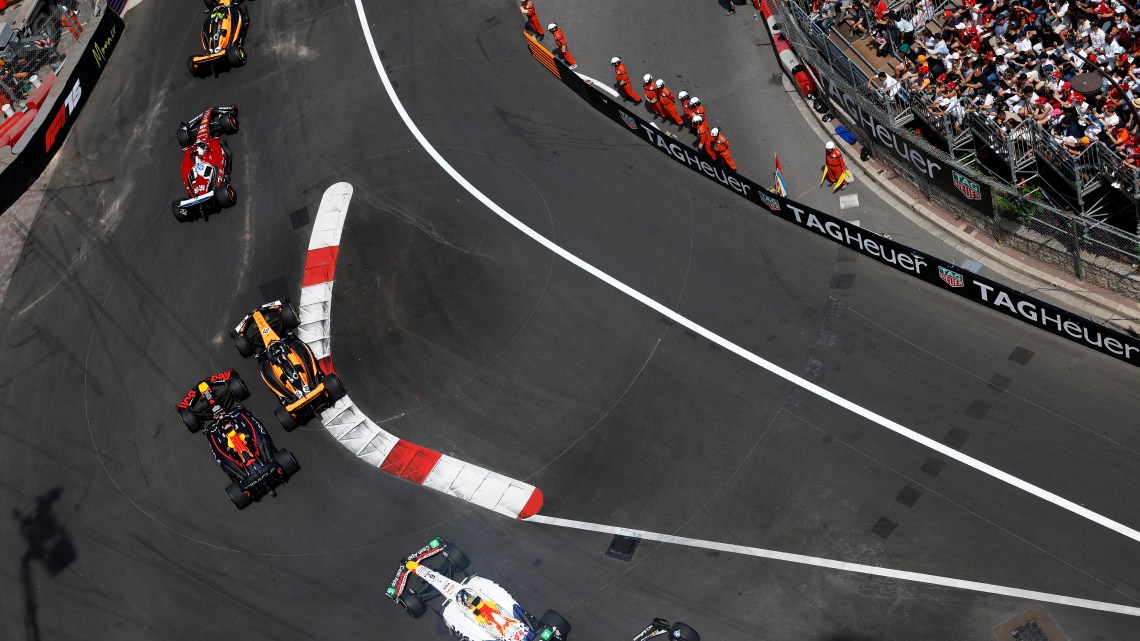
Firstly, the reason the whole regulation was introduced was because of the track itself and its notorious behaviour for on-track overtakes. As such, the race itself has been known to become a bit of a procession, meaning the drivers will follow each other for 78 laps.
During the Monaco Grand Prix, Saturday becomes the biggest day of the week with qualifying, as the drivers battle it out for their grid slot on Sunday’s race.
In recent seasons, the top 10 have finished almost identical as to their qualifying conditions. Last year, only Ferrari’s Lewis Hamilton and Fernando Alonso finished in a different spot compared to qualifying, inside the top 10, with Hamilton finishing fifth as Alonso retired.
However, in 2024, the top 10 remained unchanged, with each driver at the sharp end of the field finishing in the same position they qualified. This new rule change was meant to help reduce this from occurring and help promote overtaking during the race.
What the two-stop tried to achieve
The two-stop mandate for the 2025 Monaco Grand Prix was introduced to spice up the strategic element of the race. On a normal race weekend in Monaco, the teams and drivers would have a specific strategy in mind to preserve their track position, using a one-stop plan.
If a mid-stint safety car comes into play, the teams and drivers tend to pit under the safety car in a bid to get a cheap stop and stretch out their tyres until the end – maintaining track position where they can.
However, in theory, the two-stop was to force more strategic options from those involved, in a bid that more overtakes and less predictability would occur during the race. Overall, making the Monaco Grand Prix a more entertaining spectacle than in previous years.
Why it failed
Ahead of the Grand Prix, there was speculation that the plan might not work out in the way the FIA and F1 hoped, with speculation that those driving at the back of the grid might pull into the pits after the opening lap to get their first pit stop done and to complete their second much earlier than planned.
However, it seemed that no one – bar the teams and drivers – had thought about the potential of the teams holding up the pack to open up a space for their sister car to slot into. Thanks to the difficulty of overtaking on the streets of Monaco.
Holding up the pack was a common theme of last year’s race. Those in the midfield were the more infamous for this preferred strategy, as ill-positioned George Russell, of Mercedes, more notably, cut the Neuville chicane to overtake the Williams of Alexander Albon. Russell later took a penalty for the incident, a drive-through penalty, on the chin after he claimed Albon was driving erratically, after being held up behind the Williams for many laps.
While it was a good idea in principle and theory, the strategy and practicality of the teams and drivers made the 2025 Monaco Grand Prix more lacklustre and predictable, and less of an entertaining watch, thus failing the intended purpose of the mandated two-stop strategy.
However, it was not the fault of the teams and drivers; they were just making lemonade from a poor batch of lemons to improve their chances of points.
Read more Formula 1 here:
- Charles Leclerc extends contract with Ferrari ahead of Monaco GP
- Fernando Alonso urges more “top F1 drivers” to compete in other series
- From heartbreak to glory: Ricciardo’s iconic Monaco win
- Albon says bad luck struck again in Canada
- Sainz says Williams are “building some good momentum” after Canada recovery
- Hamilton encouraged after strongest Ferrari weekend yet
- The Writer’s Verdict: 2026 Canadian Grand Prix
Please follow us on Facebook, Instagram and Twitter to keep up with the latest news from ApexMotorsports.co.uk!

Hi, I’m Kamron. I created ApexMotorsports.co.uk in the dying embers of the 2021 Formula 1 world championship. It allowed me freedom to write whatever I wanted to write about which was all things motorsports, my passion.
I have put a lot of effort in over the years to keep this website in its best shape and I’ve loved seeing the brand grow consistently, month-on-month, year-on-year. My ambition is to keep watching this brand grow into a primary outlet of news for all things motorsports whilst fueling my desire to pursue a career in sports journalism, specialising in motorsports.
Kamron Kent

Hi, I'm Kamron. I created ApexMotorsports.co.uk in the dying embers of the 2021 Formula 1 world championship. It allowed me freedom to write whatever I wanted to write about which was all things motorsports, my passion. I have put a lot of effort in over the years to keep this website in its best shape and I've loved seeing the brand grow consistently, month-on-month, year-on-year. My ambition is to keep watching this brand grow into a primary outlet of news for all things motorsports whilst fueling my desire to pursue a career in sports journalism, specialising in motorsports.